A new study published in PLOS One, authored by CIES researchers Marta Entradas (study coordinator), Yan Feng, and Inês Carneiro e Sousa, examines the “grey areas” of scientific integrity. The study reveals that questionable research practices are common in Portuguese universities and are often perceived as minor or normalized in everyday academic life.
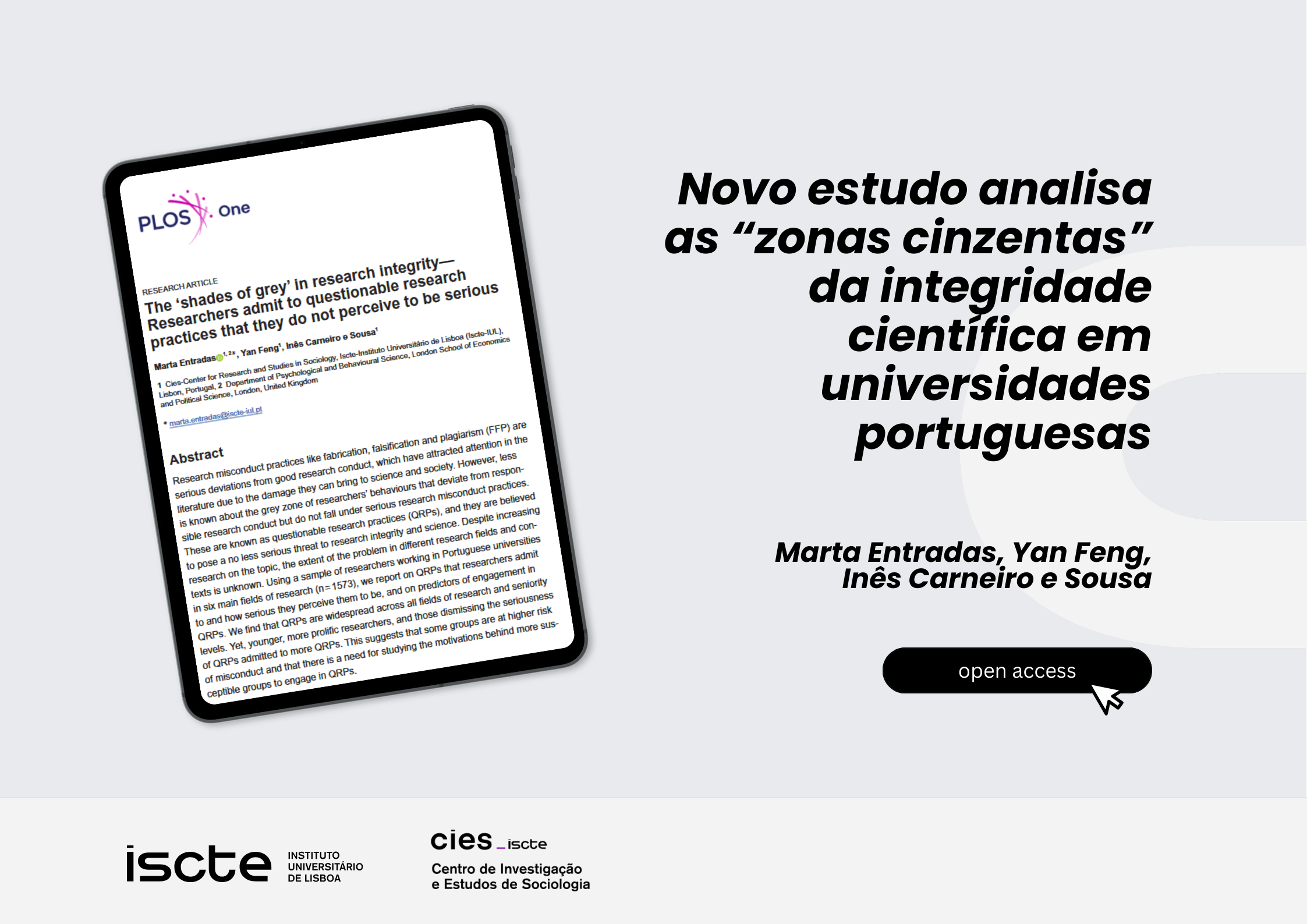
Starting from the premise that, despite good intentions, scientific practice does not always fully adhere to the principles of integrity, the study analyzes how researchers in Portuguese institutions perceive and acknowledge behaviors known as questionable research practices (QRPs). The results show that the majority of researchers admit to having engaged in at least one of these practices, particularly in matters related to authorship, citations, and literature review. The most frequently reported practice concerns the inclusion of co-authors who did not contribute to the study.
The article further identifies that younger researchers and those with a higher number of publications tend to report these behaviors more frequently. However, the perception of the (non-)seriousness of the practices emerges as the strongest determinant of such behaviors: researchers tend to report practices they do not consider serious.
Beyond individual-level factors, the authors emphasize the importance of the institutional context, highlighting the impact of publish-or-perish pressures, precarious scientific careers, and metric-based evaluation systems in normalizing these practices. The article thus contributes to a critical reflection on scientific integrity, academic culture, and research policy.