Renato Miguel do Carmo and Bruno Miguel Oliveira have published this brief as part of the POV_LEVELS project - Levels of decentralisation in the fight against poverty: new municipal powers in social action, under the Science4Policy (S4P) programme.
The document, entitled Social Policy and Decentralization: Opportunities and Challenges for a Proximity-Based Welfare State, analyses the transfer of responsibilities in the field of social action to Portuguese municipalities, as established by Lei nº 50/2018 and Decreto-Lei nº 55/2020.
The research focuses on four municipalities: Moura, Alenquer, Porto and Barreiro, selected for their socio-economic and territorial diversity. It combines the mapping of local indicators with interviews conducted with municipal decision-makers and technical staff.
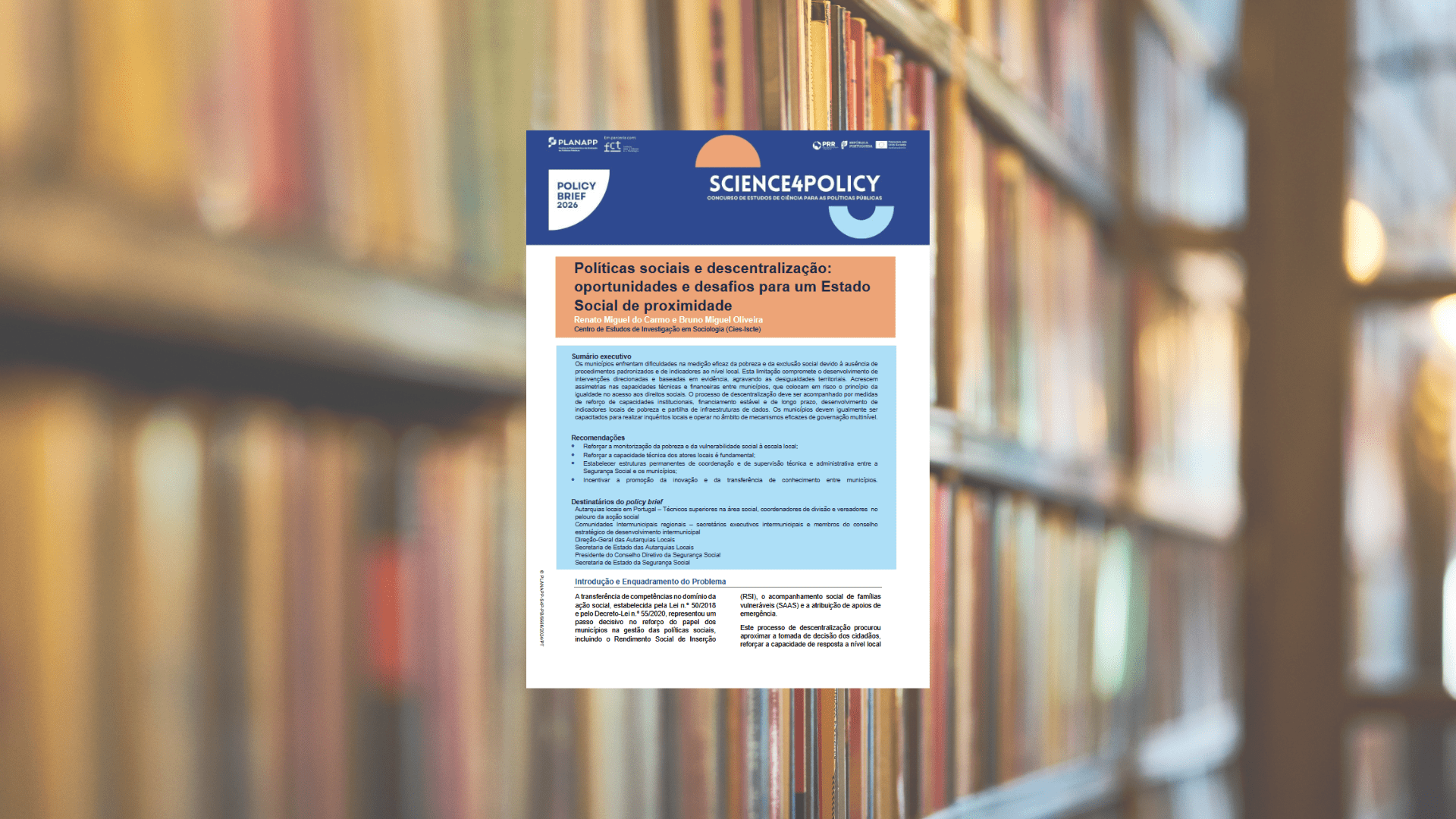
The study identifies tangible progress, notably increased institutional proximity and faster response times. However, it also highlights structural limitations that constrain territorial equity, including the absence of localized indicators on poverty and social exclusion, disparities in technical and financial capacity across municipalities, and still incomplete coordination between Social Security services and local authorities.
Based on these findings, the policy brief puts forward recommendations addressed to both national and local decision-makers. These include the development of a municipal system of social indicators, the strengthening of technical capacity within local administrations, and the establishment of permanent multi-level coordination structures between central government and municipalities.
This work is part of the first set of policy briefs released under the Science4Policy (S4P) initiative, promoted by the Fundação para a Ciência e a Tecnologia in partnership with the PLANAPP – Centro de Planeamento e de Avaliação de Políticas Públicas.