- News
- Events
- Recurring Events
- Biographies and Trajectories
- Cidades & Impérios: dinâmicas locais, fluxos globais
- Cultural Diversity in Contemporary Families
- Meetings on China Studies
- Meetings Migration Experiences
- Social studies on science and the circulation of knowledge
- Public Policy Forum
- Research Forum CIES
- Gender, Sexuality and other social markers of difference
- Language, Power, and Social Boundaries
- ETNO.URB Readings
- Social Movements and Political Action
- New Perspectives on Modern History
- Revisiting the 19th Century
- Research Workshops
- Methodological Innovation Workshops
- Calls
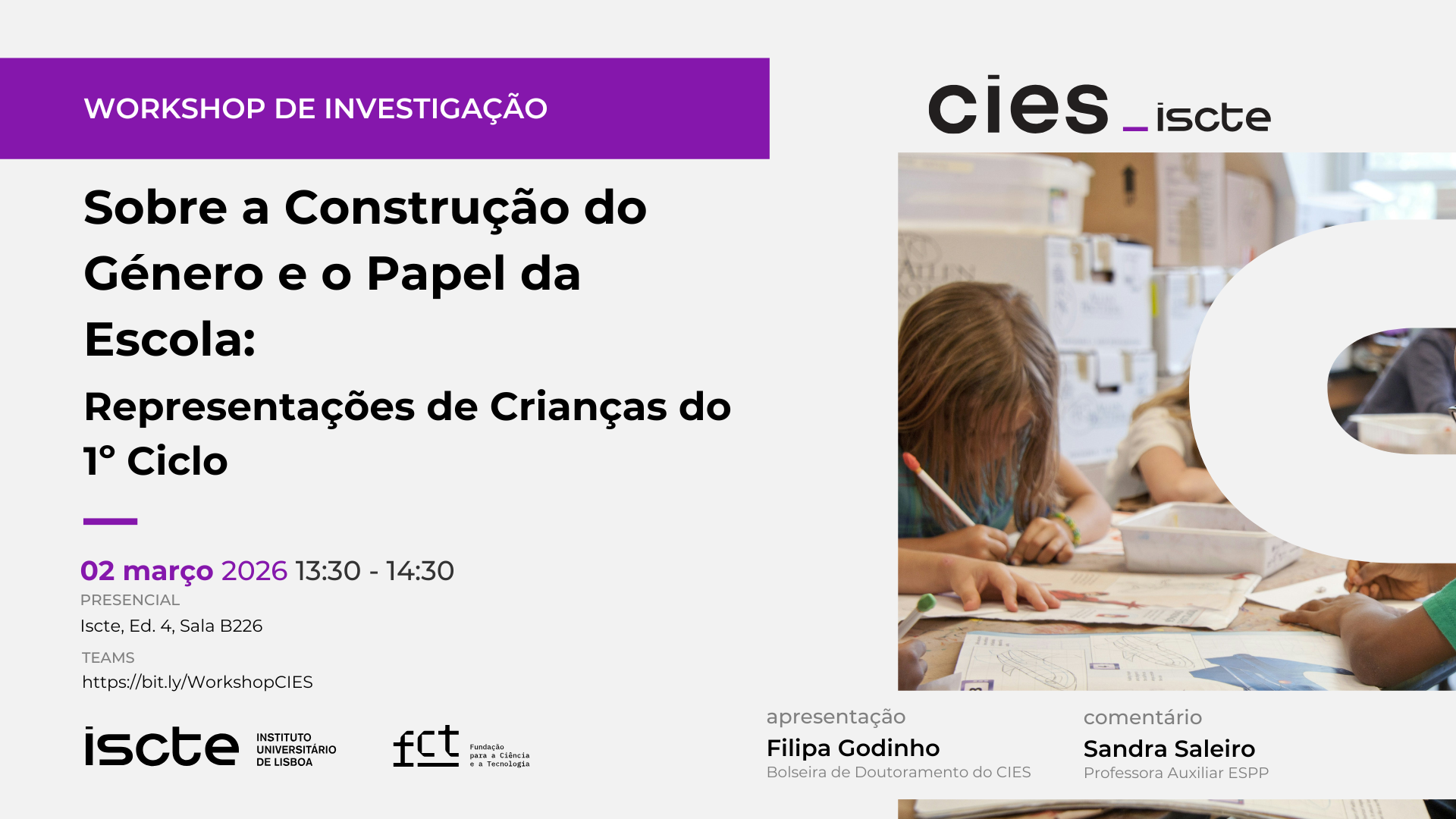
The next CIES research workshop will take place in hybrid format (on site and via Teams) on the afternoon of March 2, 2026, on the topic “On the Construction of Gender and the Role of the School: Representations of Primary School Children".
PRESENTATION
Filipa Godinho, FCT Doctoral Research Fellow
COMMENTARY
Sandra Saleiro, Assistant Professor, ESPP
LINK TEAMS
https://bit.ly/WorkshopCIES

ABSTRACT
The relationship between the school and the construction of gender has assumed increasing relevance in contemporary times. Within sociology, the school institution not only represents a privileged site for observing the interactions that children establish with those around them, but is also a key agent of socialization; for these two reasons, it constitutes a particularly appropriate setting for the study of gender issues.
The ongoing doctoral thesis, “The Construction of Gender ‘by’ and ‘in’ the School: A Case Study in a Primary School,” therefore seeks to examine the relationship between the school and the construction of gender through these two paradigms. On the one hand, it explores how children construct gender in interaction with those around them, particularly within the school, where they spend most of their daily lives; on the other hand, it considers how the context in which this occurs shapes that construction—namely, how the school itself conditions the construction of gender.
To this end, observation was conducted in a primary school over the course of one academic year, following four classes (one class per grade level, from Year 1 to Year 4). Drawings were produced with all observed children; interviews were carried out with 50 children and with the observed teachers; and materials such as textbooks, worksheets, assessment criteria, evaluation grids, handouts, and notebooks were also collected.
This workshop will give particular attention to the interviews conducted with the children, through which it is possible to access how children establish different gender categories, the characteristics with which they fill those categories, how these relate to other categories such as ethno-racial and class categories, what impact this has on how they experience their everyday lives and imagine their futures, and, finally, what role they attribute to the school in this entire process.