- News
- Events
- Recurring Events
- Biographies and Trajectories
- Cidades & Impérios: dinâmicas locais, fluxos globais
- Cultural Diversity in Contemporary Families
- Meetings on China Studies
- Meetings Migration Experiences
- Social studies on science and the circulation of knowledge
- Public Policy Forum
- Research Forum CIES
- Gender, Sexuality and other social markers of difference
- Language, Power, and Social Boundaries
- ETNO.URB Readings
- Social Movements and Political Action
- New Perspectives on Modern History
- Revisiting the 19th Century
- Research Workshops
- Methodological Innovation Workshops
- Calls
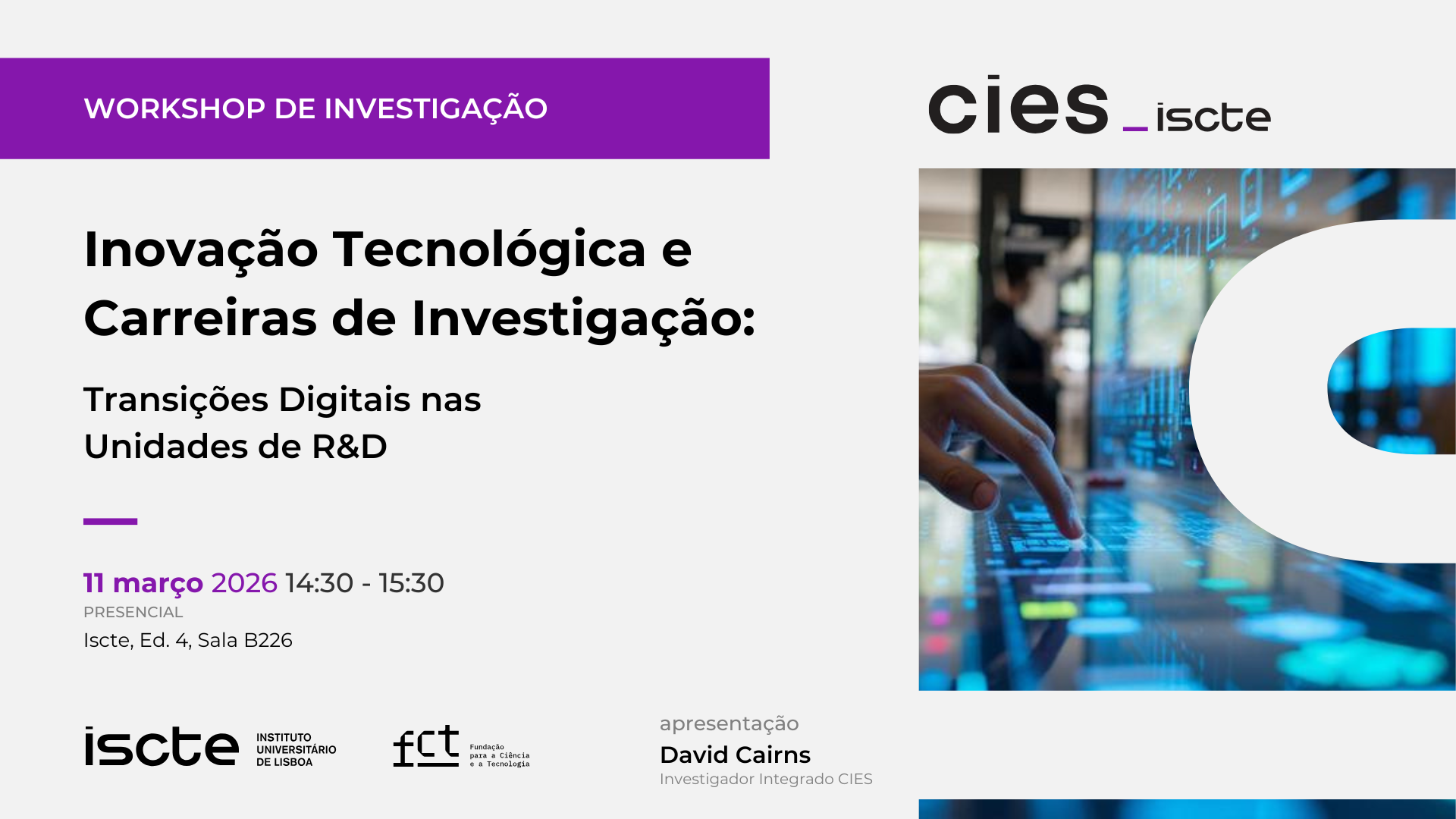
The next research workshop will take place on 11 March 2026, in room B226 of building 4 at Iscte. This workshop, dedicated to the theme "Technological Innovation and Research Careers: Digital Transitions in Portuguese Research and Development Units", will be led by CIES researcher David Cairns.
TEAMS
https://bit.ly/WorkshopCIES_Mar2026
ABSTRACT
Digitalization, defined as the heightened use of information technology and advance communications, has become an integral aspect of many professional careers, including researchers. In this workshop, we explore this development, looking at research tasks that have been digitalized and differences in use of technology according to researchers’ socio-demographic and disciplinary backgrounds. The first part of the presentation contextualizes the study in regard to pre-existing digitalization paradigms and debates at national and European levels. Following an outline of methodological approach, the second part of the presentation discusses results from a web survey conducted with 370 researchers from across Portugal during November and December 2025. Analysis confirms a high level of usage of digitalization affecting researchers, including recruitment processes, remote working and virtual mobility, with significant disparities emerging in respect to certain uses of technology. While engagement with AI and other digital tools is transversal, differences are present between scientific disciplines; for example, respondents in hard sciences display a greater propensity to engage in in-person meetings while people in the social sciences and humanities are more likely to engage in remote working. Those in the 45 to 54 age group also reported higher levels of participation in in-person events. In conclusion, we argue that while there are signs of digitalization having become hegemonic within research work, there are some disciplinary differences in regard to use of technology in networking activities, with respondents from the social sciences and the humanities showing signs of deeper engagement with digitalization, suggesting stronger adherence to technology-related innovation.